Stable Diffusion

High-Resolution Image Synthesis with Latent Diffusion Models

Stable Diffusion v2 refers to a specific configuration of the model architecture that uses a downsampling-factor 8 autoencoder with an 865M UNet and OpenCLIP ViT-H/14 text encoder for the diffusion model. The SD 2-v model produces 768x768 px outputs.

This stable-diffusion-2 model is resumed from stable-diffusion-2-base (512-base-ema.ckpt) and trained for 150k steps using a v-objective on the same dataset. Resumed for another 140k steps on 768x768 images.

image

Model Details

Examples

Using the 🤗’s Diffusers library to run Stable Diffusion 2 in a simple and efficient manner.

VideoBLIP

VideoBLIP is an augmented BLIP-2 that can handle videos.

Bias, Risks, Limitations, and Ethical Considerations

VideoBLIP has not been tested in real world applications. It should not be directly deployed in any applications. Researchers should first carefully assess the safety and fairness of the model in relation to the specific context they’re being deployed within.

How to use

For code examples, please refer to the official repository.

InstructBLIP

InstructBLIP model using Flan-T5-xl as language model. InstructBLIP was introduced in the paper InstructBLIP: Towards General-purpose Vision-Language Models with Instruction Tuning by Dai et al.

Disclaimer: The team releasing InstructBLIP did not write a model card for this model so this model card has been written by the Hugging Face team.

Model description

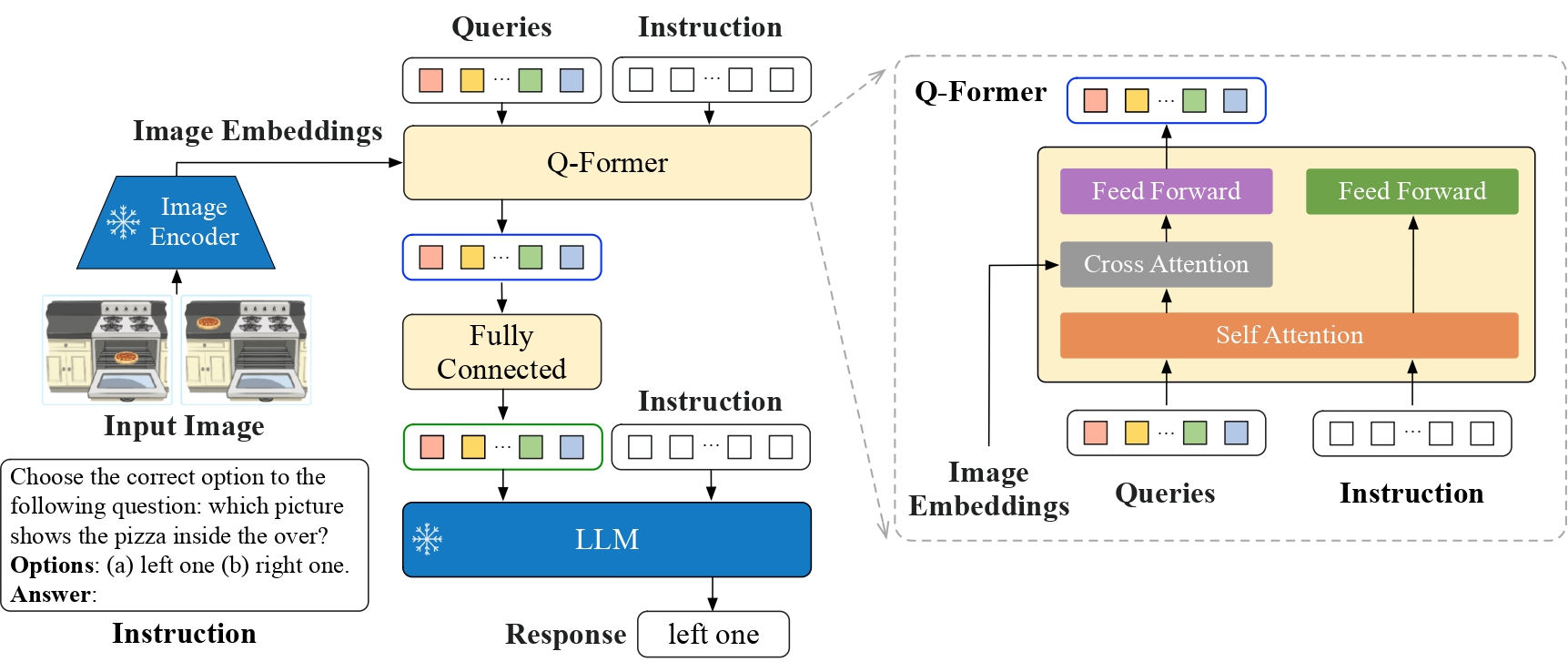
InstructBLIP is a visual instruction tuned version of BLIP-2. Refer to the paper for details.

InstructBLIP architecture

Blip

Bootstrapping Language-Image Pre-training for Unified Vision-Language Understanding and Generation

Model card for BLIP trained on image-text matching - base architecture (with ViT base backbone).

BLIP.gif
Pull figure from BLIP official repo

TL;DR

Authors from the paper write in the abstract:

Vision-Language Pre-training (VLP) has advanced the performance for many vision-language tasks. However, most existing pre-trained models only excel in either understanding-based tasks or generation-based tasks. Furthermore, performance improvement has been largely achieved by scaling up the dataset with noisy image-text pairs collected from the web, which is a suboptimal source of supervision. In this paper, we propose BLIP, a new VLP framework which transfers flexibly to both vision-language understanding and generation tasks. BLIP effectively utilizes the noisy web data by bootstrapping the captions, where a captioner generates synthetic captions and a filter removes the noisy ones. We achieve state-of-the-art results on a wide range of vision-language tasks, such as image-text retrieval (+2.7% in average recall@1), image captioning (+2.8% in CIDEr), and VQA (+1.6% in VQA score). BLIP also demonstrates strong generalization ability when directly transferred to videolanguage tasks in a zero-shot manner. Code, models, and datasets are released.

Usage

You can use this model for conditional and un-conditional image captioning

Blip 2

It was introduced in the paper BLIP-2: Bootstrapping Language-Image Pre-training with Frozen Image Encoders and Large Language Models by Li et al. and first released in this repository.

Disclaimer: The team releasing BLIP-2 did not write a model card for this model so this model card has been written by the Hugging Face team.

Model description

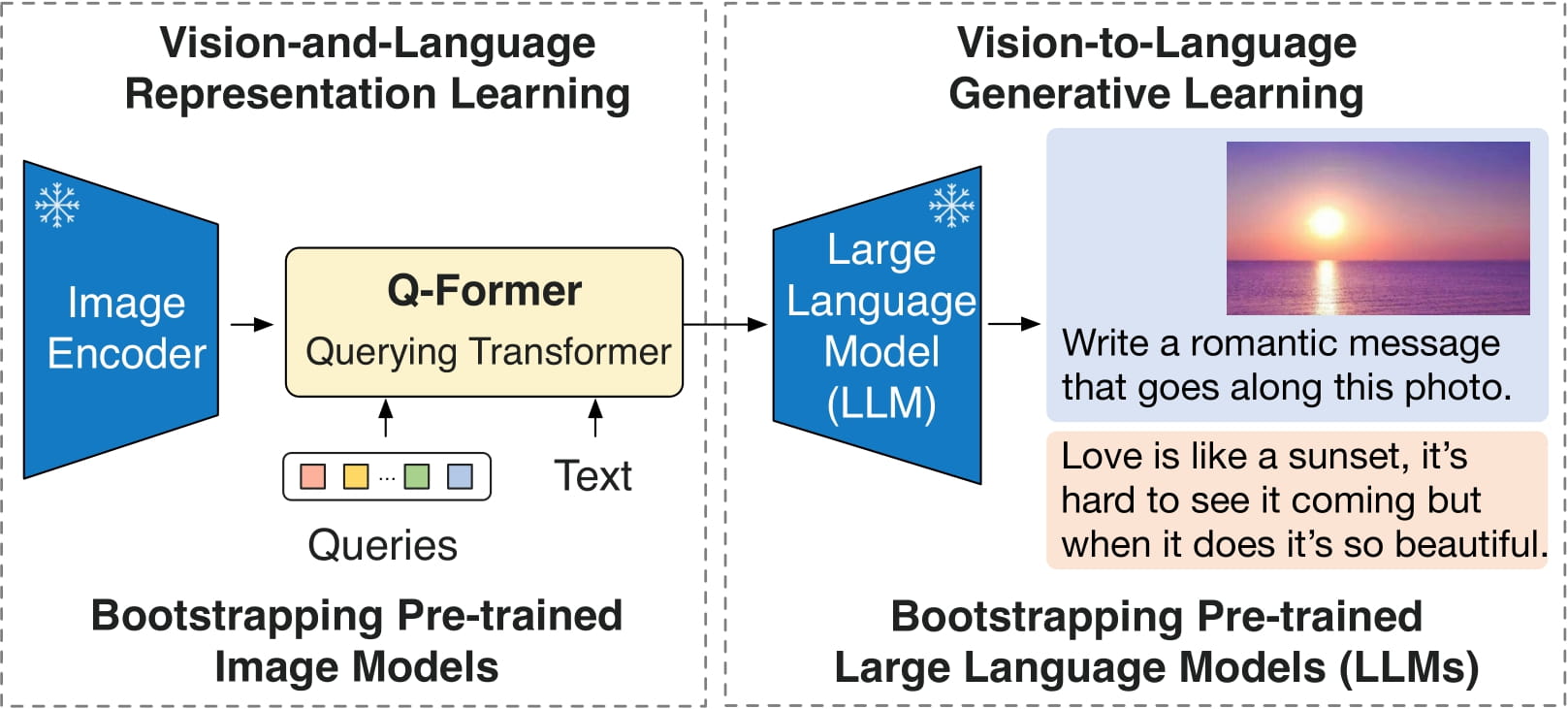
BLIP-2 consists of 3 models: a CLIP-like image encoder, a Querying Transformer (Q-Former) and a large language model.

The authors initialize the weights of the image encoder and large language model from pre-trained checkpoints and keep them frozen
while training the Querying Transformer, which is a BERT-like Transformer encoder that maps a set of “query tokens” to query embeddings,
which bridge the gap between the embedding space of the image encoder and the large language model.

The goal for the model is simply to predict the next text token, giving the query embeddings and the previous text.

drawing

This allows the model to be used for tasks like:

  • image captioning
  • visual question answering (VQA)
  • chat-like conversations by feeding the image and the previous conversation as prompt to the model

Direct Use and Downstream Use

You can use the raw model for conditional text generation given an image and optional text. See the model hub to look for
fine-tuned versions on a task that interests you.

Bias, Risks, Limitations, and Ethical Considerations

BLIP2 is fine-tuned on image-text datasets (e.g. LAION ) collected from the internet. As a result the model itself is potentially vulnerable to generating equivalently inappropriate content or replicating inherent biases in the underlying data.

BLIP2 has not been tested in real world applications. It should not be directly deployed in any applications. Researchers should first carefully assess the safety and fairness of the model in relation to the specific context they’re being deployed within.

Blip 2 OPT-2.7b

BLIP-2, OPT-2.7b, pre-trained only

BLIP-2 model, leveraging OPT-2.7b (a large language model with 2.7 billion parameters).
It was introduced in the paper BLIP-2: Bootstrapping Language-Image Pre-training with Frozen Image Encoders and Large Language Models by Li et al. and first released in this repository.

Disclaimer: The team releasing BLIP-2 did not write a model card for this model so this model card has been written by the Hugging Face team.

Model description

BLIP-2 consists of 3 models: a CLIP-like image encoder, a Querying Transformer (Q-Former) and a large language model.

The authors initialize the weights of the image encoder and large language model from pre-trained checkpoints and keep them frozen
while training the Querying Transformer, which is a BERT-like Transformer encoder that maps a set of “query tokens” to query embeddings,
which bridge the gap between the embedding space of the image encoder and the large language model.

The goal for the model is simply to predict the next text token, giving the query embeddings and the previous text.

drawing

This allows the model to be used for tasks like:

  • image captioning
  • visual question answering (VQA)
  • chat-like conversations by feeding the image and the previous conversation as prompt to the model

Direct Use and Downstream Use

You can use the raw model for conditional text generation given an image and optional text. See the model hub to look for
fine-tuned versions on a task that interests you.

Bias, Risks, Limitations, and Ethical Considerations

BLIP2-OPT uses off-the-shelf OPT as the language model. It inherits the same risks and limitations as mentioned in Meta’s model card.

Like other large language models for which the diversity (or lack thereof) of training
data induces downstream impact on the quality of our model, OPT-175B has limitations in terms
of bias and safety. OPT-175B can also have quality issues in terms of generation diversity and
hallucination. In general, OPT-175B is not immune from the plethora of issues that plague modern
large language models.

BLIP2 is fine-tuned on image-text datasets (e.g. LAION ) collected from the internet. As a result the model itself is potentially vulnerable to generating equivalently inappropriate content or replicating inherent biases in the underlying data.

BLIP2 has not been tested in real world applications. It should not be directly deployed in any applications. Researchers should first carefully assess the safety and fairness of the model in relation to the specific context they’re being deployed within.

text-embedding-ada-002

  • Better: it outperforms prior OpenAI models on most benchmark tasks.

  • Simpler: a single model for both search and similarity tasks across both text and code.

  • Able to read 4x more: it can embed up to 8,191 tokens (roughly ~10 pages) vs. 2,046 previously.

MODEL GENERATION TOKENIZER MAX INPUT TOKENS KNOWLEDGE CUTOFF
V2 cl100k_base 8191 Sep 2021
V1 GPT-2/GPT-3 2046 Aug 2020
MODEL NAME TOKENIZER MAX INPUT TOKENS OUTPUT DIMENSIONS
text-embedding-ada-002 cl100k_base 8191 1536

Llama 2

Llama 2 is a collection of pretrained and fine-tuned generative text models ranging in scale from 7 billion to 70 billion parameters. This is the repository for the 7B pretrained model. Links to other models can be found in the index at the bottom.

Model Details

Note: Use of this model is governed by the Meta license. In order to download the model weights and tokenizer, please visit the website and accept our License before requesting access here.

Meta developed and publicly released the Llama 2 family of large language models (LLMs), a collection of pretrained and fine-tuned generative text models ranging in scale from 7 billion to 70 billion parameters. Our fine-tuned LLMs, called Llama-2-Chat, are optimized for dialogue use cases. Llama-2-Chat models outperform open-source chat models on most benchmarks we tested, and in our human evaluations for helpfulness and safety, are on par with some popular closed-source models like ChatGPT and PaLM.

Model Developers Meta

Variations Llama 2 comes in a range of parameter sizes — 7B, 13B, and 70B — as well as pretrained and fine-tuned variations.

Input Models input text only.

Output Models generate text only.

Model Architecture Llama 2 is an auto-regressive language model that uses an optimized transformer architecture. The tuned versions use supervised fine-tuning (SFT) and reinforcement learning with human feedback (RLHF) to align to human preferences for helpfulness and safety.

Llama 2 family of models. Token counts refer to pretraining data only. All models are trained with a global batch-size of 4M tokens. Bigger models - 70B – use Grouped-Query Attention (GQA) for improved inference scalability.

Model Dates Llama 2 was trained between January 2023 and July 2023.

Status This is a static model trained on an offline dataset. Future versions of the tuned models will be released as we improve model safety with community feedback.

License A custom commercial license is available at: https://ai.meta.com/resources/models-and-libraries/llama-downloads/

Research Paper “Llama-2: Open Foundation and Fine-tuned Chat Models”

Intended Use

Intended Use Cases Llama 2 is intended for commercial and research use in English. Tuned models are intended for assistant-like chat, whereas pretrained models can be adapted for a variety of natural language generation tasks.

To get the expected features and performance for the chat versions, a specific formatting needs to be followed, including the INST and <<SYS>> tags, BOS and EOS tokens, and the whitespaces and breaklines in between (we recommend calling strip() on inputs to avoid double-spaces). See our reference code in github for details: chat_completion.

Out-of-scope Uses Use in any manner that violates applicable laws or regulations (including trade compliance laws).Use in languages other than English. Use in any other way that is prohibited by the Acceptable Use Policy and Licensing Agreement for Llama 2.

Hardware and Software

Training Factors We used custom training libraries, Meta’s Research Super Cluster, and production clusters for pretraining. Fine-tuning, annotation, and evaluation were also performed on third-party cloud compute.

Carbon Footprint Pretraining utilized a cumulative 3.3M GPU hours of computation on hardware of type A100-80GB (TDP of 350-400W). Estimated total emissions were 539 tCO2eq, 100% of which were offset by Meta’s sustainability program.

Time (GPU hours) Power Consumption (W) Carbon Emitted(tCO2eq)
Llama 2 7B 184320 400 31.22
Llama 2 13B 368640 400 62.44
Llama 2 70B 1720320 400 291.42
Total 3311616 539.00

CO2 emissions during pretraining. Time: total GPU time required for training each model. Power Consumption: peak power capacity per GPU device for the GPUs used adjusted for power usage efficiency. 100% of the emissions are directly offset by Meta’s sustainability program, and because we are openly releasing these models, the pretraining costs do not need to be incurred by others.

Training Data

Overview Llama 2 was pretrained on 2 trillion tokens of data from publicly available sources. The fine-tuning data includes publicly available instruction datasets, as well as over one million new human-annotated examples. Neither the pretraining nor the fine-tuning datasets include Meta user data.

Data Freshness The pretraining data has a cutoff of September 2022, but some tuning data is more recent, up to July 2023.

Evaluation Results

In this section, we report the results for the Llama 1 and Llama 2 models on standard academic benchmarks.For all the evaluations, we use our internal evaluations library.

Model Size Code Commonsense Reasoning World Knowledge Reading Comprehension Math MMLU BBH AGI Eval
Llama 1 7B 14.1 60.8 46.2 58.5 6.95 35.1 30.3 23.9
Llama 1 13B 18.9 66.1 52.6 62.3 10.9 46.9 37.0 33.9
Llama 1 33B 26.0 70.0 58.4 67.6 21.4 57.8 39.8 41.7
Llama 1 65B 30.7 70.7 60.5 68.6 30.8 63.4 43.5 47.6
Llama 2 7B 16.8 63.9 48.9 61.3 14.6 45.3 32.6 29.3
Llama 2 13B 24.5 66.9 55.4 65.8 28.7 54.8 39.4 39.1
Llama 2 70B 37.5 71.9 63.6 69.4 35.2 68.9 51.2 54.2

Overall performance on grouped academic benchmarks. Code: We report the average pass@1 scores of our models on HumanEval and MBPP. Commonsense Reasoning: We report the average of PIQA, SIQA, HellaSwag, WinoGrande, ARC easy and challenge, OpenBookQA, and CommonsenseQA. We report 7-shot results for CommonSenseQA and 0-shot results for all other benchmarks. World Knowledge: We evaluate the 5-shot performance on NaturalQuestions and TriviaQA and report the average. Reading Comprehension: For reading comprehension, we report the 0-shot average on SQuAD, QuAC, and BoolQ. MATH: We report the average of the GSM8K (8 shot) and MATH (4 shot) benchmarks at top 1.

TruthfulQA Toxigen
Llama 1 7B 27.42 23.00
Llama 1 13B 41.74 23.08
Llama 1 33B 44.19 22.57
Llama 1 65B 48.71 21.77
Llama 2 7B 33.29 21.25
Llama 2 13B 41.86 26.10
Llama 2 70B 50.18 24.60

Evaluation of pretrained LLMs on automatic safety benchmarks. For TruthfulQA, we present the percentage of generations that are both truthful and informative (the higher the better). For ToxiGen, we present the percentage of toxic generations (the smaller the better).

TruthfulQA Toxigen
Llama-2-Chat 7B 57.04 0.00
Llama-2-Chat 13B 62.18 0.00
Llama-2-Chat 70B 64.14 0.01

Evaluation of fine-tuned LLMs on different safety datasets. Same metric definitions as above.

Ethical Considerations and Limitations

Llama 2 is a new technology that carries risks with use. Testing conducted to date has been in English, and has not covered, nor could it cover all scenarios. For these reasons, as with all LLMs, Llama 2’s potential outputs cannot be predicted in advance, and the model may in some instances produce inaccurate, biased or other objectionable responses to user prompts. Therefore, before deploying any applications of Llama 2, developers should perform safety testing and tuning tailored to their specific applications of the model.

Please see the Responsible Use Guide available at https://ai.meta.com/llama/responsible-use-guide/

Reporting Issues

Please report any software “bug,” or other problems with the models through one of the following means:

Llama Model Index

Model Llama2 Llama2-hf Llama2-chat Llama2-chat-hf
7B Link Link Link Link
13B Link Link Link Link
70B Link Link Link Link

Llama 2

Llama 2 is a collection of pretrained and fine-tuned generative text models ranging in scale from 7 billion to 70 billion parameters. This is the repository for the 13B fine-tuned model, optimized for dialogue use cases and converted for the Hugging Face Transformers format. Links to other models can be found in the index at the bottom.

Model Details

Note: Use of this model is governed by the Meta license. In order to download the model weights and tokenizer, please visit the website and accept our License before requesting access here.

Meta developed and publicly released the Llama 2 family of large language models (LLMs), a collection of pretrained and fine-tuned generative text models ranging in scale from 7 billion to 70 billion parameters. Our fine-tuned LLMs, called Llama-2-Chat, are optimized for dialogue use cases. Llama-2-Chat models outperform open-source chat models on most benchmarks we tested, and in our human evaluations for helpfulness and safety, are on par with some popular closed-source models like ChatGPT and PaLM.

Model Developers Meta

Variations Llama 2 comes in a range of parameter sizes — 7B, 13B, and 70B — as well as pretrained and fine-tuned variations.

Input Models input text only.

Output Models generate text only.

Model Architecture Llama 2 is an auto-regressive language model that uses an optimized transformer architecture. The tuned versions use supervised fine-tuning (SFT) and reinforcement learning with human feedback (RLHF) to align to human preferences for helpfulness and safety.

Training Data Params Content Length GQA Tokens LR
Llama 2 A new mix of publicly available online data 7B 4k 2.0T 3.0 x 10⁻⁴
Llama 2 A new mix of publicly available online data 13B 4k 2.0T 3.0 x 10⁻⁴
Llama 2 A new mix of publicly available online data 70B 4k 2.0T 1.5 x 10⁻⁴

Llama 2 family of models. Token counts refer to pretraining data only. All models are trained with a global batch-size of 4M tokens. Bigger models - 70B – use Grouped-Query Attention (GQA) for improved inference scalability.

Model Dates Llama 2 was trained between January 2023 and July 2023.

Status This is a static model trained on an offline dataset. Future versions of the tuned models will be released as we improve model safety with community feedback.

License A custom commercial license is available at: https://ai.meta.com/resources/models-and-libraries/llama-downloads/

Research Paper “Llama-2: Open Foundation and Fine-tuned Chat Models”

Intended Use

Intended Use Cases Llama 2 is intended for commercial and research use in English. Tuned models are intended for assistant-like chat, whereas pretrained models can be adapted for a variety of natural language generation tasks.

To get the expected features and performance for the chat versions, a specific formatting needs to be followed, including the INST and <<SYS>> tags, BOS and EOS tokens, and the whitespaces and breaklines in between (we recommend calling strip() on inputs to avoid double-spaces). See our reference code in github for details: chat_completion.

Out-of-scope Uses Use in any manner that violates applicable laws or regulations (including trade compliance laws).Use in languages other than English. Use in any other way that is prohibited by the Acceptable Use Policy and Licensing Agreement for Llama 2.

Hardware and Software

Training Factors We used custom training libraries, Meta’s Research Super Cluster, and production clusters for pretraining. Fine-tuning, annotation, and evaluation were also performed on third-party cloud compute.

Carbon Footprint Pretraining utilized a cumulative 3.3M GPU hours of computation on hardware of type A100-80GB (TDP of 350-400W). Estimated total emissions were 539 tCO2eq, 100% of which were offset by Meta’s sustainability program.

Time (GPU hours) Power Consumption (W) Carbon Emitted(tCO2eq)
Llama 2 7B 184320 400 31.22
Llama 2 13B 368640 400 62.44
Llama 2 70B 1720320 400 291.42
Total 3311616 539.00

CO2 emissions during pretraining. Time: total GPU time required for training each model. Power Consumption: peak power capacity per GPU device for the GPUs used adjusted for power usage efficiency. 100% of the emissions are directly offset by Meta’s sustainability program, and because we are openly releasing these models, the pretraining costs do not need to be incurred by others.

Training Data

Overview Llama 2 was pretrained on 2 trillion tokens of data from publicly available sources. The fine-tuning data includes publicly available instruction datasets, as well as over one million new human-annotated examples. Neither the pretraining nor the fine-tuning datasets include Meta user data.

Data Freshness The pretraining data has a cutoff of September 2022, but some tuning data is more recent, up to July 2023.

Evaluation Results

In this section, we report the results for the Llama 1 and Llama 2 models on standard academic benchmarks.For all the evaluations, we use our internal evaluations library.

Model Size Code Commonsense Reasoning World Knowledge Reading Comprehension Math MMLU BBH AGI Eval
Llama 1 7B 14.1 60.8 46.2 58.5 6.95 35.1 30.3 23.9
Llama 1 13B 18.9 66.1 52.6 62.3 10.9 46.9 37.0 33.9
Llama 1 33B 26.0 70.0 58.4 67.6 21.4 57.8 39.8 41.7
Llama 1 65B 30.7 70.7 60.5 68.6 30.8 63.4 43.5 47.6
Llama 2 7B 16.8 63.9 48.9 61.3 14.6 45.3 32.6 29.3
Llama 2 13B 24.5 66.9 55.4 65.8 28.7 54.8 39.4 39.1
Llama 2 70B 37.5 71.9 63.6 69.4 35.2 68.9 51.2 54.2

Overall performance on grouped academic benchmarks. Code: We report the average pass@1 scores of our models on HumanEval and MBPP. Commonsense Reasoning: We report the average of PIQA, SIQA, HellaSwag, WinoGrande, ARC easy and challenge, OpenBookQA, and CommonsenseQA. We report 7-shot results for CommonSenseQA and 0-shot results for all other benchmarks. World Knowledge: We evaluate the 5-shot performance on NaturalQuestions and TriviaQA and report the average. Reading Comprehension: For reading comprehension, we report the 0-shot average on SQuAD, QuAC, and BoolQ. MATH: We report the average of the GSM8K (8 shot) and MATH (4 shot) benchmarks at top 1.

TruthfulQA Toxigen
Llama 1 7B 27.42 23.00
Llama 1 13B 41.74 23.08
Llama 1 33B 44.19 22.57
Llama 1 65B 48.71 21.77
Llama 2 7B 33.29 21.25
Llama 2 13B 41.86 26.10
Llama 2 70B 50.18 24.60

Evaluation of pretrained LLMs on automatic safety benchmarks. For TruthfulQA, we present the percentage of generations that are both truthful and informative (the higher the better). For ToxiGen, we present the percentage of toxic generations (the smaller the better).

TruthfulQA Toxigen
Llama-2-Chat 7B 57.04 0.00
Llama-2-Chat 13B 62.18 0.00
Llama-2-Chat 70B 64.14 0.01

Evaluation of fine-tuned LLMs on different safety datasets. Same metric definitions as above.

Ethical Considerations and Limitations

Llama 2 is a new technology that carries risks with use. Testing conducted to date has been in English, and has not covered, nor could it cover all scenarios. For these reasons, as with all LLMs, Llama 2’s potential outputs cannot be predicted in advance, and the model may in some instances produce inaccurate, biased or other objectionable responses to user prompts. Therefore, before deploying any applications of Llama 2, developers should perform safety testing and tuning tailored to their specific applications of the model.

Please see the Responsible Use Guide available at https://ai.meta.com/llama/responsible-use-guide/

Reporting Issues

Please report any software “bug,” or other problems with the models through one of the following means:

Llama Model Index
Model Llama2 Llama2-hf Llama2-chat Llama2-chat-hf
7B Link Link Link Link
13B Link Link Link Link
70B Link Link Link Link

Vicuna

Vicuna is a chat assistant trained by fine-tuning Llama 2 on user-shared conversations collected from ShareGPT.

Model Details

  • Developed by: LMSYS
  • Model type: An auto-regressive language model based on the transformer architecture
  • License: Llama 2 Community License Agreement
  • Finetuned from model: Llama 2

Model Sources

Uses

The primary use of Vicuna is research on large language models and chatbots.
The primary intended users of the model are researchers and hobbyists in natural language processing, machine learning, and artificial intelligence.

How to Get Started with the Model

Model Weights

Weights version Link Base Model Release Date Fine-tuning Data
v1.5 7B, 7B-16k, 13B, 13B-16k Llama 2 Aug. 1, 2023 370M tokens
v1.3 7B, 13B, 33B Llama 1 Jun. 22, 2023 370M tokens
v1.1 7B, 13B Llama 1 Apr. 12, 2023 -
v0 7B-delta, 13B-delta Llama 1 Mar. 30, 2023 -

Training Details

Vicuna v1.5 (16k) is fine-tuned from Llama 2 with supervised instruction fine-tuning and linear RoPE scaling.
The training data is around 125K conversations collected from ShareGPT.com. These conversations are packed into sequences that contain 16K tokens each.
See more details in the “Training Details of Vicuna Models” section in the appendix of this paper.

Evaluation

Evaluation Results

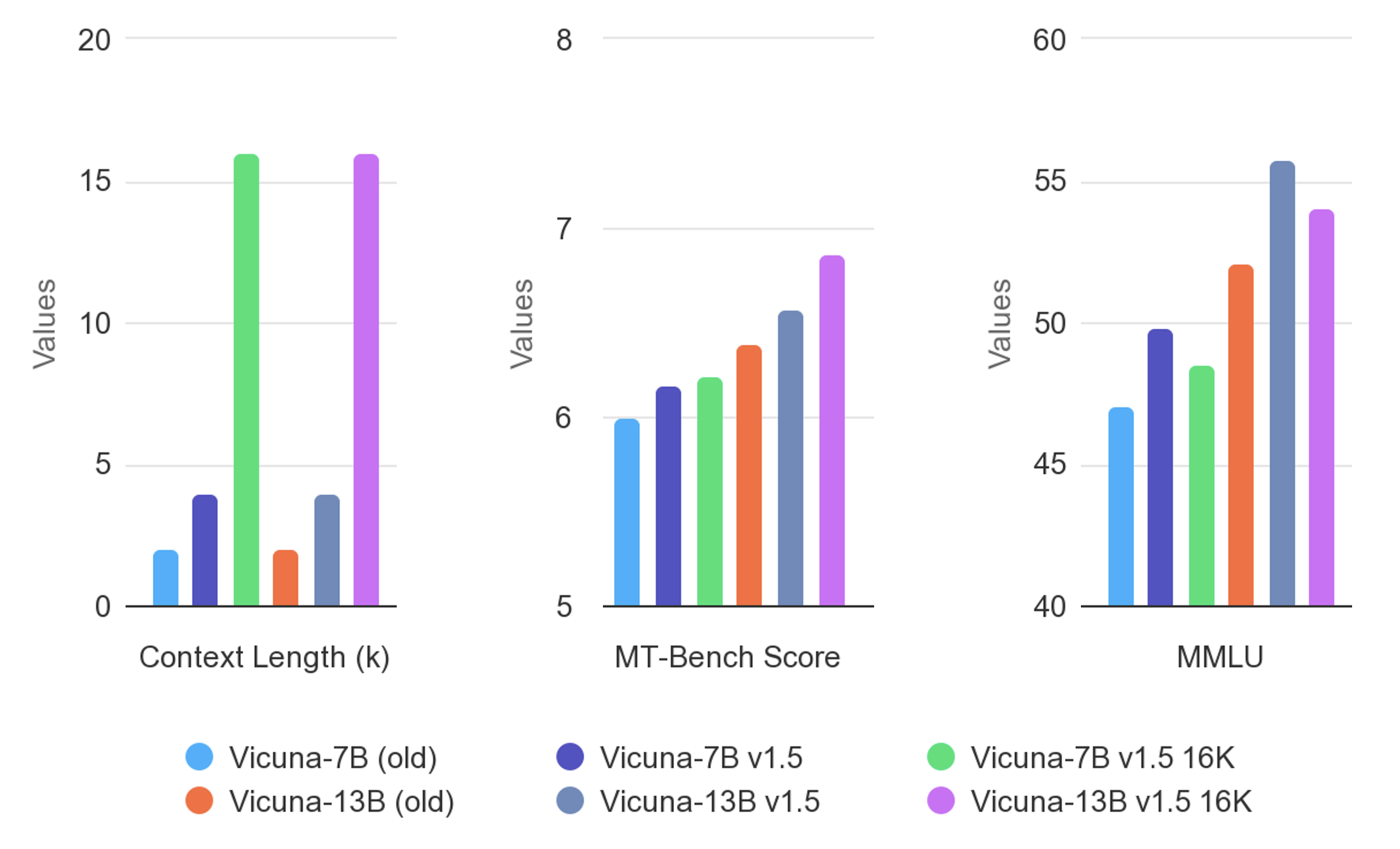
Vicuna is evaluated with standard benchmarks, human preference, and LLM-as-a-judge. See more details in this paper and leaderboard.

Difference between different versions of Vicuna

See vicuna_weights_version.md